View of the Patent Office Building, circa 1840, National Portrait Gallery, Smithsonian Institution
On July 4, 1836, President Andrew Jackson authorized construction of the United States Patent Office’s new headquarters. Staff moved into the still-unfinished building in 1840.
Construction begins
1836
Patent models on display at the Patent Office Building during the Civil War, Public domain via Wikimedia Commons
In the 1850s, more than 100,000 people visited the Patent Office Building annually, browsing dozens of display cases filled with patent models, scientific specimens and historic treasures— including the Declaration of Independence
A national gallery
1850s
Soldiers from the First Rhode Island Infantry Regiment sleep in bunks in the Patent Office Building, NPG
During the Civil War, the Patent Office Building served as a temporary hospital. Poet and journalist Walt Whitman visited the wounded, reflecting on the stark juxtaposition between the artifacts on display and the “suffering and death” unfolding in the makeshift hospital’s halls.
Civil War hospital
1861-1863
An 1860 portrait of Abraham Lincoln, NPG
Abraham Lincoln held his second inaugural ball in the Patent Office Building on March 6, 1865. More than 4,000 guests attended the celebration, which took place just five and a half weeks before the president was assassinated.
Lincoln’s second inaugural ball
1865
A circa 1865 photo of the Patent Office Building, NPG
On September 24, 1877, a blaze broke out at the Patent Office Building, severely damaging its north and west wings. Although the fire destroyed a number of drawings and patent models, no patents were completely lost.
A fire at the Patent Office
1877
An official portrait of Dwight D. Eisenhower, Public domain via Wikimedia Common
The Patent Office moved out of its longtime home in 1932, leaving the Civil Service Commission to oversee the building. After the commission vacated the site in 1953, a congressman suggested razing the historic structure to make way for a parking lot. Eisenhower’s intervention saved the building from destruction
President Dwight D. Eisenhower saves the historic building
1955
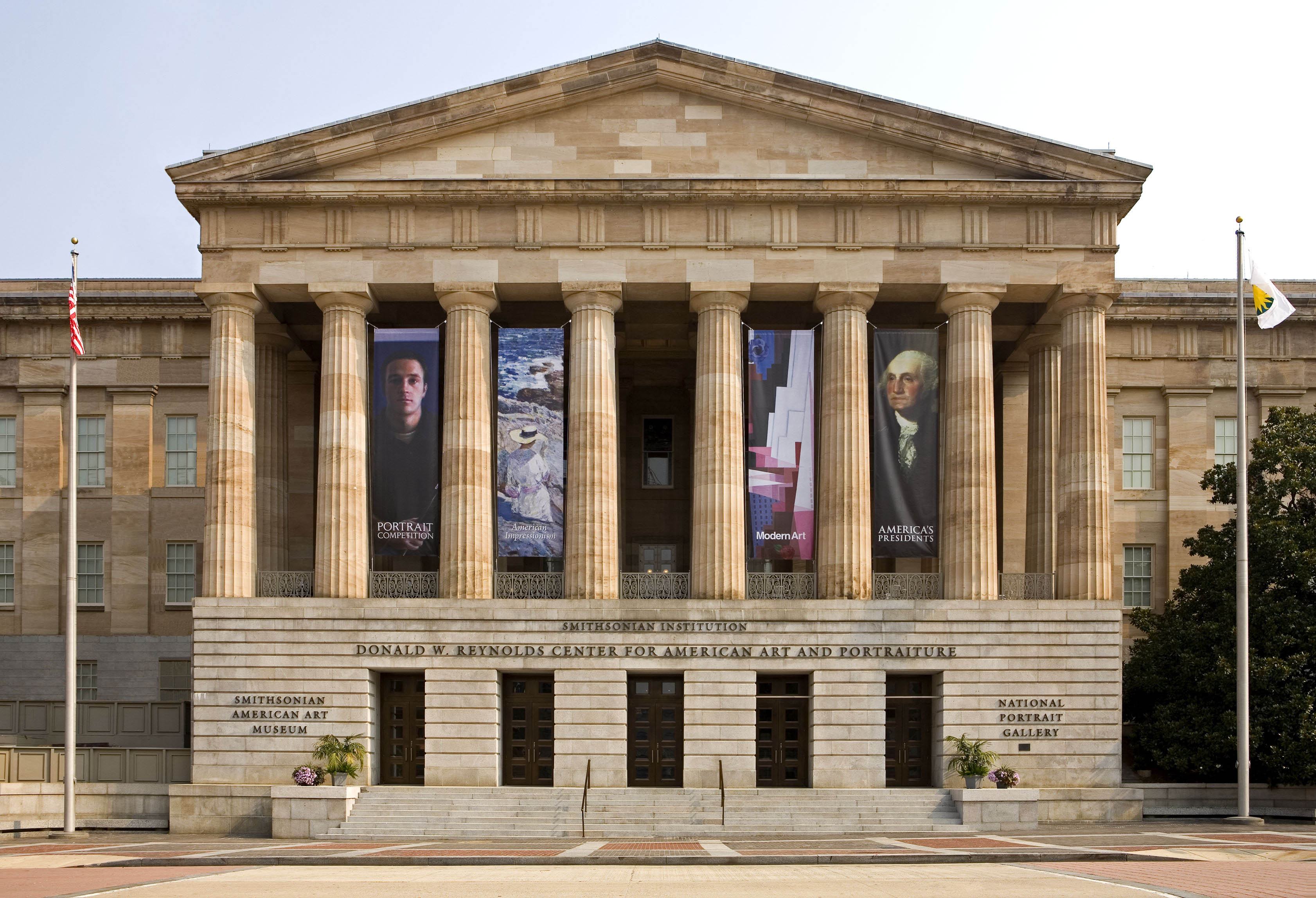
The exterior of the Donald W. Reynolds Center for American Art and Portraiture, home to the Smithsonian American Art Museum and the National Portrait Gallery, Smithsonian Institution
Eisenhower and Congress transferred the Patent Office Building to the Smithsonian Institution in 1958. The Smithsonian American Art Museum (then known as the National Collection of Fine Arts) opened to the public on May 9, 1968; the National Portrait Gallery followed on October 7.
SAAM and NPG open to the public
1968